homely
A home-automation hobby turned into a tidy open-source integration – a Home Assistant custom component for the Homely alarm with push updates and a fallback, plus unofficial API documentation.
- Context
- Personal
- Period
- Oct 2025 – ongoing
- Code
- bjafl/homely-ha
Background
I run Home Assistant at home, and my Homely alarm was one of the things that would not join in. Homely offers an SDK API for customers, but its documentation is incomplete: some endpoints are described, while the WebSocket events and many of the data fields you have to work out yourself. The solutions others had built were MQTT-based.
So I made it a proper project: an integration that behaves like a built-in part of Home Assistant, and a separate repo that documents the API the way it actually behaves, so others do not have to guess.
What I built
homely-ha is a Home Assistant custom component (installed through HACS as a custom repository).
- Real-time first. One Socket.IO connection per location delivers instant changes from sensors and the alarm. If the connection drops, the integration retries with exponential backoff (30 seconds up to 5 minutes, at most six attempts).
- REST as the fallback. The REST API fetches the full state at startup and takes over when push is not working. The polling interval follows connection health: 30 minutes when every location has live push, 30 seconds with none.
- Polite to the API. If Homely answers that I have called too often, the integration pauses calls for at least two minutes and serves the last known state meanwhile. Expired credentials trigger Home Assistant’s standard re-authentication flow.
- Multiple locations from one Home Assistant install, chosen in the setup dialog and changed later under “Configure”.
- Entities: motion, door/window, flood, smoke, tamper and battery as binary sensors; alarm state, temperature, signal strength and power/energy as sensors; and a button for manual refresh. Norwegian and English translations.
homely-api-docs is an unofficial OpenAPI 3.0.3 specification of the same API: the five REST endpoints, the
device-state-changed and alarm-state-changed events, data models and practical pitfalls (the WebSocket is Socket.IO
rather than a raw WebSocket, the token in the URL needs the right encoding, and the API is read-only). The spec is
validated and linted in GitHub Actions and published as Swagger UI on GitHub Pages. The README says openly that the
content was compiled from Homely’s PDF documentation and community projects, refined with help from Claude, and may
contain mistakes.
Architecture
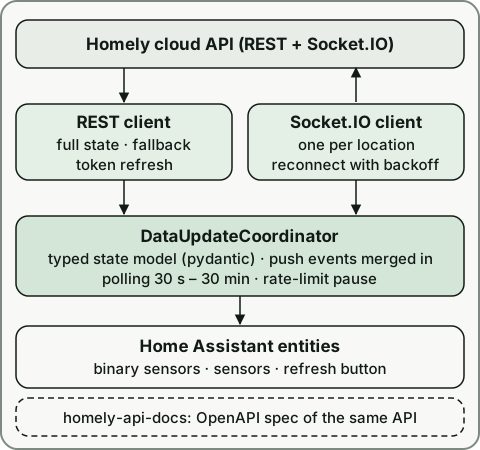
The coordinator is the glue. It keeps each location’s state in a pydantic model, accepts both REST responses and push events, and notifies the entities when something changes. Unknown event types are captured as their own type instead of breaking the connection.
Tech
Python 3.13 with asyncio, Home Assistant’s DataUpdateCoordinator and config flow, python-socketio for real-time and
pydantic for the models. Quality tooling: ruff, mypy, codespell and pre-commit hooks, CI on GitHub Actions, and around
185 tests with pytest and Home Assistant’s test tooling. The repo also has a docker compose file that starts a Home
Assistant instance for manual testing. The README states 85% test coverage.
What I learned
- Reliability is mostly failure paths. Showing a sensor value is the easy part. The time went into what happens when the connection drops, the token expires or the API says stop – and still showing the user a correct state.
- Documentation is part of the product. Writing the API down as it behaves, with OpenAPI and CI validation, forced me to understand it better than the code alone did, and makes it useful to people other than me.
- Following a platform’s conventions. Config flow, re-authentication, translations and Home Assistant’s quality requirements gave me a frame to build against. The project follows a quality tier (Bronze) that I assessed myself; it is not an official approval.
- Honest status. The integration is read-only (no arming/disarming) and cloud-dependent, and the README says so. It was developed with Claude Code as a tool, which the repo states openly.