e2ee-drop
A self-hosted service for end-to-end encrypted file transfer, rewritten from scratch after a serverless prototype – with accounts, key recovery and permanent links.
- Context
- Personal
- Period
- Sept 2026 – ongoing
- Code
- bjafl/e2ee-drop
Background
Sensitive files usually travel by e-mail or through a cloud service that can read them. I wanted the recipient to create a link and the sender to upload, with the file encrypted in the sender’s browser before it leaves the machine.
The first attempt, e2ee-file-drop (2025), was a serverless prototype: Netlify Functions and Netlify Blobs, storage in
Backblaze B2 through presigned URLs, and encryption with tweetnacl (nacl.box) in a Web Worker. It worked, but it was narrow. The whole file is encrypted in memory in a single call, so large files hit the browser’s memory
limit. The recipient’s private key sat in localStorage in one browser with a 24-hour lifetime, so clearing the browser
or switching device meant the file could never be decrypted. And there were no accounts and no tests.
e2ee-drop is the rewrite: the same idea, as a service you can run yourself.
What I built
- The anonymous flow, as before. No account needed: the recipient creates a one-time link, and the key pair stays in
the recipient’s browser (
localStorage, optionally PIN-protected). - Accounts with key management. At registration the browser generates a key pair and wraps the private key
(
nacl.secretbox) with a key derived from the password using Argon2id. The server stores only the wrapped key. Login does not send the password either, but a separate Argon2id derivation, so the server cannot compute the key that unwraps the private key. - A recovery code. A second wrapped copy of the key is locked by a code shown once. With it you can change password without losing data; without it the account’s links and files must be deleted, and the service says so plainly.
- Permanent links and an inbox. Each account has a fixed personal link and can create more, with a contact list, visibility (public or contacts only), live status over Server-Sent Events, a storage quota and a retention period per link.
- Verification codewords. Sender and recipient each derive a short word phrase from the recipient’s public key and compare it aloud. A wrong or tampered link shows up as a mismatch.
- Two-factor (TOTP), e-mail verification, password reset, Norwegian and English UI, and light/dark mode.
Architecture
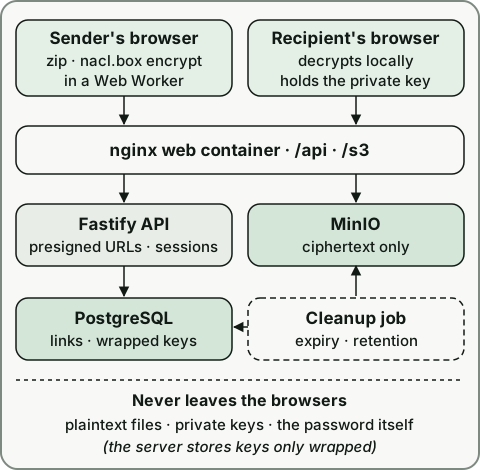
The code is a pnpm monorepo: a React app, a Fastify API and shared packages for types, codewords and the database
(Prisma). The whole stack starts with docker compose up. The API hands out presigned URLs, so file bytes travel directly between browser and storage and never through API code.
The threat model is narrow and concrete: the server should never see plaintext or private keys. File names, file type and message are encrypted together with the file, so the server does not see them. It does see the remaining metadata – who sends to whom, file size, timing, account e-mail and contacts – and stores the ciphertext. It has not been audited by anyone else. Anonymous links are bearer links – anyone holding the link can disrupt the exchange, though the content stays safe – and that is written down as a deliberate choice in the design spec.
Tech
React, Vite and Tailwind on the frontend; Fastify, Prisma and PostgreSQL on the backend; MinIO with an S3 API for files.
tweetnacl (box = X25519 + XSalsa20-Poly1305, secretbox) for encryption, hash-wasm for Argon2id, fflate for zipping
multiple files and otpauth for TOTP. Docker Compose for operations, and more than 60 test files with Vitest across the API,
frontend and shared packages.
What I learned
- A prototype shows what is missing. The limitations I wrote down in the prototype became the requirements list for the rewrite, above all for key management: a key that lives in one browser is not a usable product.
- Key management is harder than the encryption itself. Keeping the password, the login proof and the wrapping key
apart, so the server can unlock nothing, took more thought than
nacl.box. - Be honest about what remains. The rewrite still encrypts each file in memory in one call, and file size is capped (500 MB by default, configurable); streaming encryption is the next step, not something I have solved.
- Spec and plan first. The repo has design specs and implementation plans, and the project was built spec- and plan-driven, with AI assistance.